

Plant closures, scrapped shifts and drastic profit warnings at Europe’s car conglomerates are no longer isolated incidents but the symptom of a deep fracture. For decades seen as the foundation of Europe’s industrial prosperity and technological leadership, the car industry is now squeezed between ambitious political decarbonisation deadlines and the aggressive arrival of Chinese electric vehicles that are more competitive on both price and technology.
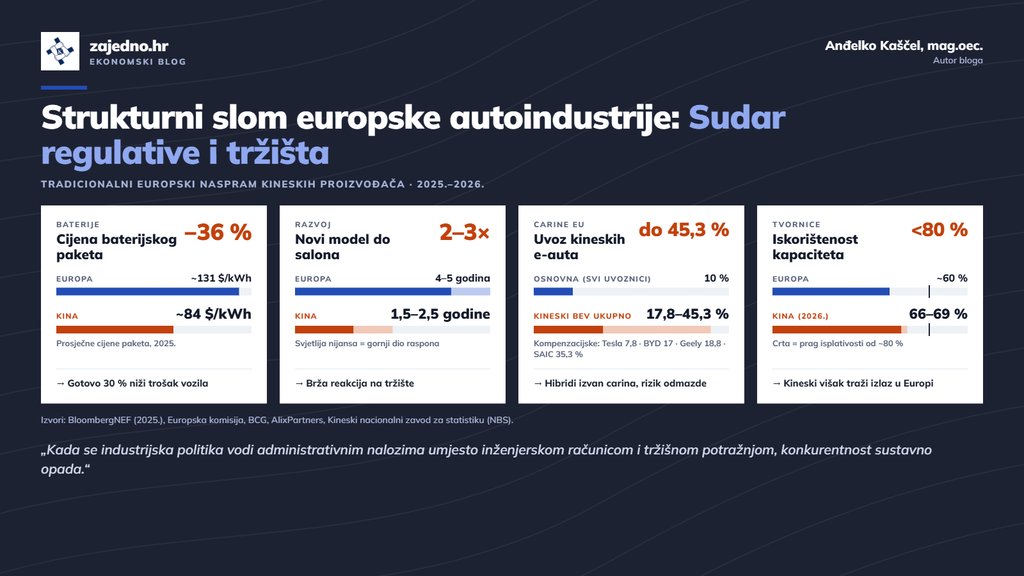
The European Union’s attempt to protect its home market with countervailing duties on Chinese electric cars (7.8 to 35.3 percent, on top of the standard 10 percent) offers only temporary relief. The duties do not cover plug-in hybrids, and Chinese manufacturers are increasingly moving production into the EU (BYD to Hungary, Chery to Spain). Chinese producers control almost the entire battery value chain and enjoy cheaper energy and much lower labour costs, giving them a cost advantage of almost 30 percent. Chinese plants are not full either: capacity utilisation stands at 66 to 69 percent, so surplus output is looking for export markets, above all Europe. At the same time, CO₂ reduction targets still force European manufacturers into a hard choice, even though the EU has already softened them with three-year averaging for 2025–2027 and a proposal to lower the 2035 target from 100 to 90 percent. They can pay fines or buy emission credits from competitors, or push expensive models onto a market where buyers are losing purchasing power.
When industrial policy is driven by administrative mandates rather than sound engineering economics and market demand, competitiveness steadily declines. For the regional supply chain, from makers of precision metal assemblies and cables to plastics, this means the era of predictable long-term orders is over. Only suppliers that urgently diversify into other industries and reduce their dependence on the automotive sector will survive.