

While Western economies focus mainly on software, financial services and green regulation, they often overlook the fact that modern industry cannot be built on virtual assumptions. Not a single electric motor, battery, wind turbine or modern defence system can be made without specific metals and minerals. The export restrictions China has imposed in recent years on gallium, germanium, antimony, graphite and rare earths have clearly shown how dependent the global production system is on Beijing’s strategic moves. The broadest of them, from October 2025, remains only suspended. Beijing recently extended the suspension to 10 January 2027, giving industry just a few weeks of breathing space.
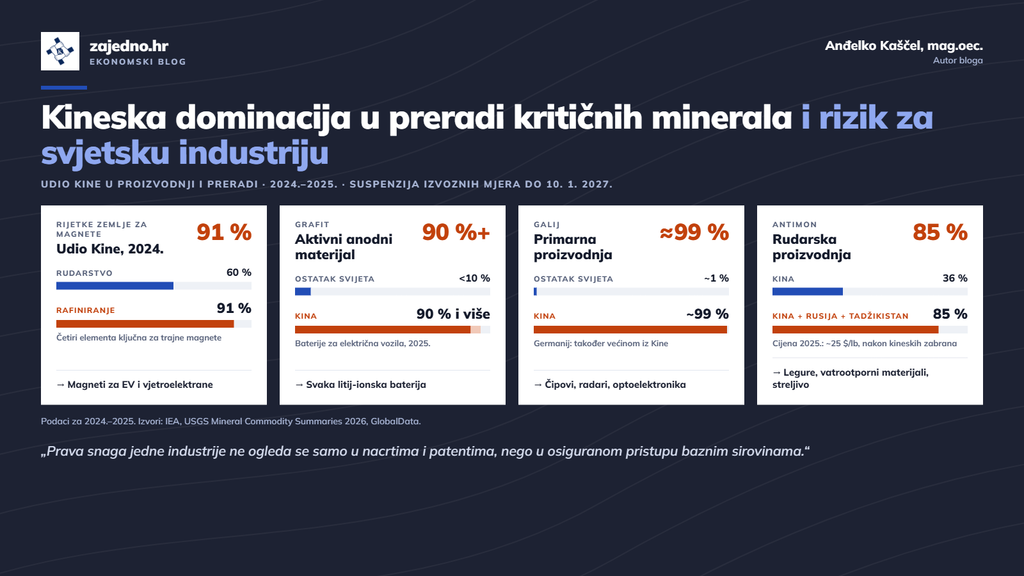
China’s dominance rests not only on owning mines but above all on controlling processing and refining capacity. According to the International Energy Agency, in 2024 China accounted for 91 percent of global refined output of the four rare earth elements essential for permanent magnets, even though its share of their mining was 60 percent. That gap shows where the real power lies. In 2025 China also produced more than 90 percent of the world’s active anode material for electric-vehicle batteries and almost all of the world’s gallium. The IEA estimates that full enforcement of China’s restrictions could put 6.5 trillion dollars of annual industrial output outside China at risk. Opening new mines in Europe or North America takes more than ten years, and building processing plants 5 to 10 years, because of strict environmental procedures and local opposition. In the meantime, Western industry faces sudden price spikes and administrative quotas that turn the sourcing of basic raw materials into a permanent operational risk.
It is impossible to plan the energy and digital transition without control over the physical materials it is built from. The real strength of an industry lies not only in its designs and patents but in secure access to basic raw materials. Industrial companies must build circular-economy and recycling principles directly into their production processes, develop alternative alloys and stop treating materials procurement as a routine administrative function.