

Americans are electing a new Congress today, but whatever the outcome of the midterms, the trend European exporters have feared for years is already a reality: the era of open multilateral markets is rapidly giving way to aggressive economic nationalism. When the US Supreme Court struck down the tariffs imposed under emergency powers in February, the administration replaced them within four days with tariffs on a different legal basis. First a temporary 10 percent duty on all imports, then, from July, tariffs of 10 to 12.5 percent on imports from some sixty economies. Goods from the European Union now face up to 15 percent under the EU–US trade agreement, steel and aluminium as much as 50 percent, and most Chinese products around 37.5 percent, with electric vehicles above 100 percent. Tariffs are no longer political rhetoric; they have become the foundation of a US trade strategy aimed at bringing industrial production back home.
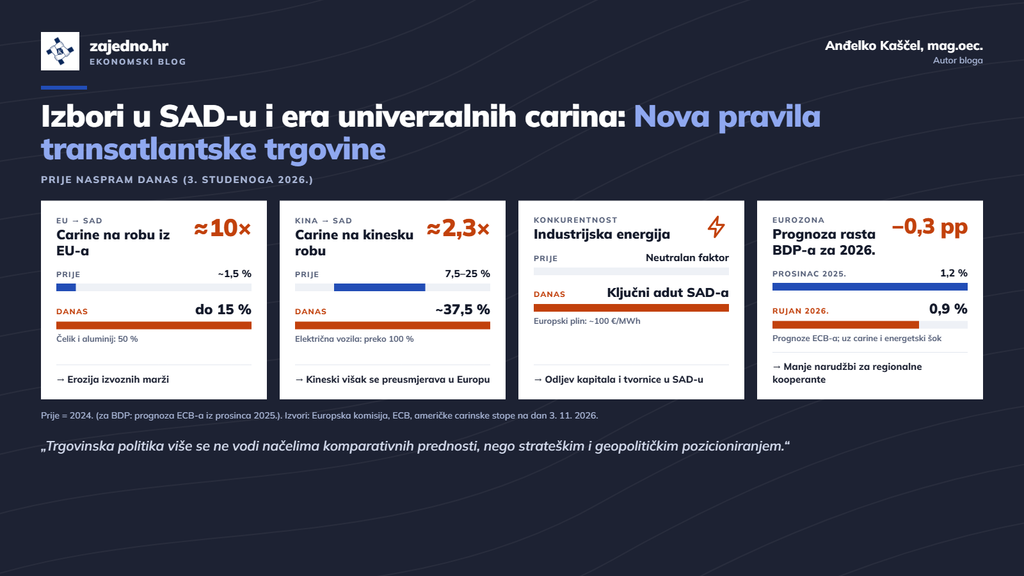
For the European economy, and especially for German industry on which the supply chains of Central and South-Eastern Europe depend, this protectionist turn is a direct blow to profitability. In September, the European Central Bank cut its 2026 eurozone growth forecast to 0.9 percent, down from the 1.2 percent it expected in December. The main cause is the energy shock from the Middle East, but the ECB cites US tariffs as a persistent drag on European competitiveness. At the same time, American competitors enjoy much cheaper domestic energy and generous tax incentives. The result is not just falling exports of finished goods, but growing pressure on European companies to move production to US soil to get around tariff barriers, while Chinese goods the US market no longer absorbs are increasingly diverted to Europe.
Business models that for decades counted on the US as an open, unlimited export market must be rebuilt for the new reality. Trade policy is no longer driven by comparative advantage, but by strategic and geopolitical positioning. Successful companies no longer ask how to ship a container across the ocean at the lowest tariff, but how to establish a local presence or diversify their export markets before the tariff barrier rises too high.