

The four largest US tech giants - Microsoft, Alphabet, Amazon and Meta - plan to invest around $735 billion this year, almost twice as much as last year, mostly in computing infrastructure for artificial intelligence, promising an immediate transformation of corporate productivity. However, the exponential expansion of data centres has unexpectedly hit the hardest possible wall: the capacity of the power grid. While algorithms and software models evolve in cycles of a few months, building power plants, substations and transmission lines moves at the pace of traditional heavy industry and takes years.
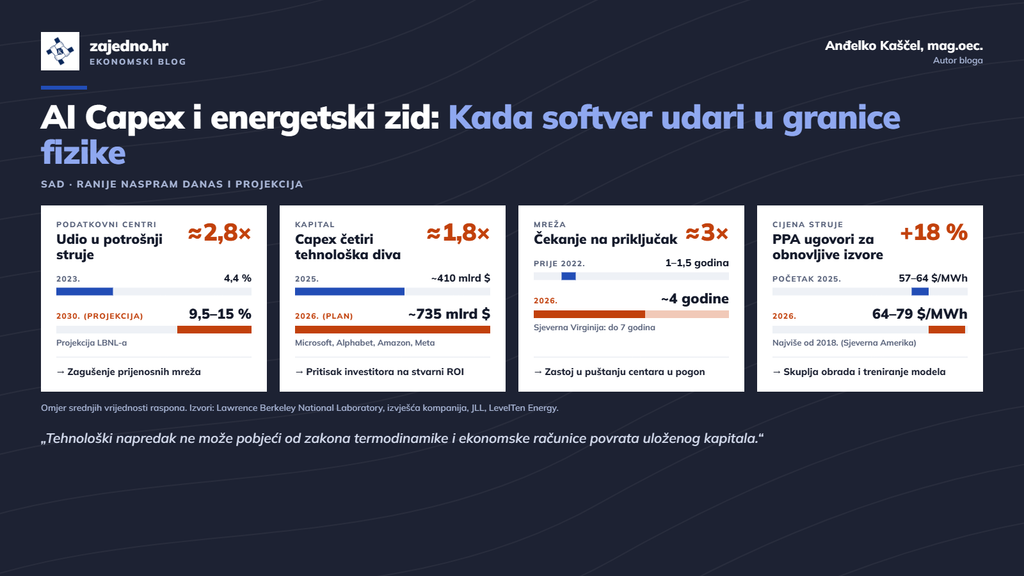
According to projections by the US Lawrence Berkeley National Laboratory, data centres’ share of US electricity consumption could rise from 4.4 percent (2023) to between 9.5 and 15 percent by 2030. Connecting a large data centre to the US grid now takes about four years on average, and up to seven years in Northern Virginia, the world’s largest data centre hub. As a result, tech companies are signing direct long-term power purchase agreements with nuclear plants and investing in small modular reactors (SMRs), while North American renewable power purchase agreement prices are at their highest since 2018. At the same time, financial markets are starting to question capital expenditure (capex) that has grown from around $410 billion in 2025 to a planned $735 billion this year, while actual revenues from business use of AI tools are growing at a much slower and more cautious pace.
Technological progress cannot escape the laws of thermodynamics or the economics of return on capital. Sustainable competitive advantage in the coming phase will not go to those who simply train bigger models, but to those who solve the energy-efficiency problem and prove tangible operational value. When the digital world runs into physical infrastructure limits, value is not created by the loudest marketing narrative, but by the engineering solution that can deliver results at a sustainable cost per kilowatt-hour.