

Announcements of parallel financial systems and of BRICS moving away from the US dollar have sparked debate about an accelerated end to the dominance of the Western financial order. The freezing of sovereign FX reserves and the selective exclusion of certain banks from SWIFT have shown that international payment infrastructure has become a geopolitical tool. As a result, many emerging economies are looking for alternative settlement mechanisms, from China’s CIPS to the mBridge platform, now run by the central banks of China, Hong Kong, Thailand, the UAE and Saudi Arabia.
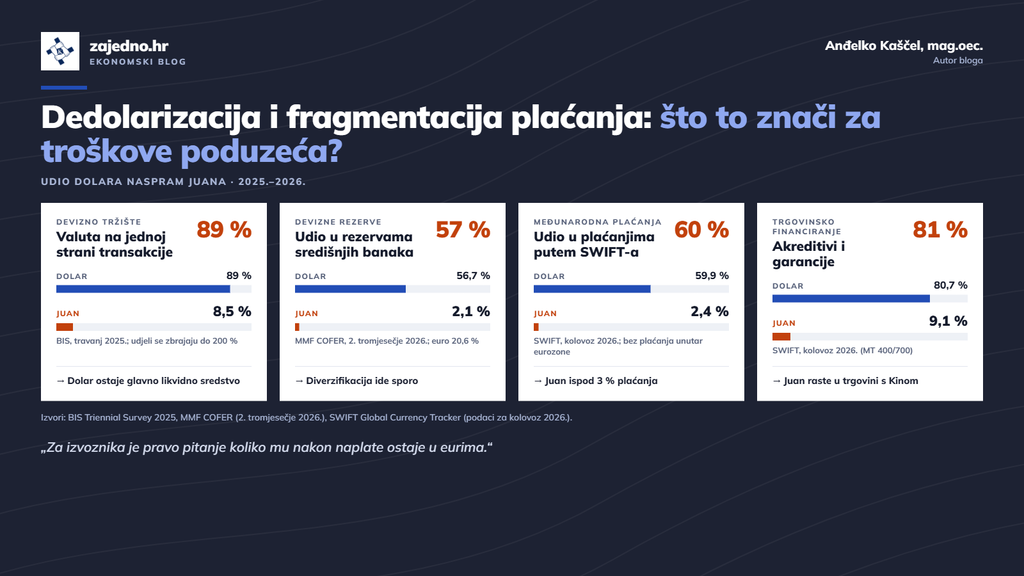
Economic practice, however, reveals a deep gap between political declarations and reality. Bilateral trade in national currencies such as the yuan, rupee or dirham has grown considerably, but it carries hidden costs: thin currency liquidity, few instruments to hedge exchange-rate risk and the problem of “trapped cash” that cannot be freely reinvested. The dollar is still on one side of 89 percent of all FX transactions worldwide and makes up almost 57 percent of central bank reserves. The yuan stands at 8.5 and 2 percent on the same measures. Instead of a new global currency, payments are splintering in ways that make international trade more expensive and more complex.
For an exporter, the real question is how much is left in euros after payment comes in. A Croatian manufacturer that invoices in yuan and pays its Chinese suppliers from the same inflows can reduce its need for conversion. If its wages, materials and loans are mostly in euros, it should compare the offered exchange rate, the cost of hedging and the payment term before signing the deal. A payment channel can speed up settlement, but those terms decide how much the deal actually earns.