

As central banks try to balance the fight against inflation with efforts to avoid a deeper recession, the gap in economic strength between the United States and Europe has created a serious monetary divide. Both central banks raised interest rates this autumn in response to an energy shock that pushed inflation to almost twice their target. Their starting points, however, are very different. The US Federal Reserve, supported by resilient domestic consumption and a strong labour market, holds its rate at 3.75 to 4.00 percent, and markets expect another hike in December. The European Central Bank has raised its deposit rate to 2.50 percent in an economy growing at barely one percent a year, leaving it caught between inflation and anaemic growth.
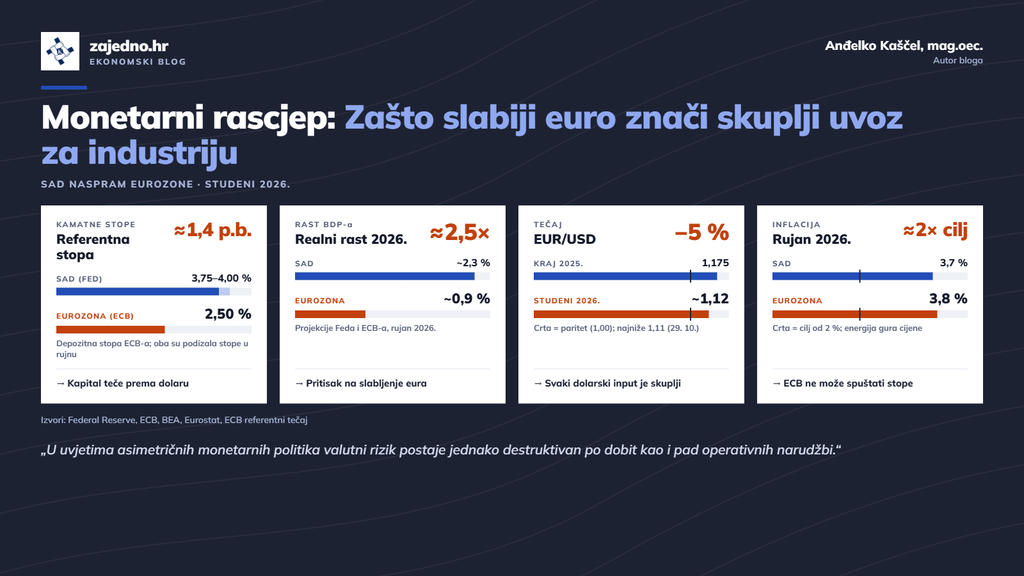
This yield gap directly weakens the euro against the US dollar. The euro has lost about five percent of its value since the start of the year and fell to its lowest level of the year at the end of October. While simplified economic theory often treats a weaker currency as a boost for exports, in today’s European reality it is a double-edged sword. Almost all key industrial inputs, from crude oil, liquefied natural gas and coal to alloys, semiconductors and specialised tools, are priced in dollars on global exchanges. A weaker euro automatically means more expensive imported inputs for domestic factories. It also feeds the very inflation that prevents the ECB from lowering interest rates.
Financial planning can no longer rest on the assumption of stable exchange rates. Under asymmetric monetary policies, currency risk becomes as destructive to profits as a fall in operating orders. Business leaders must put active FX forward hedging in place, align the currency of their revenues with the currency of their purchases as closely as possible, and stop waiting passively for monetary authorities to solve the problems of the real economy.