

The war that broke out in late February between the United States and Israel on one side and Iran on the other has turned the most sensitive point in international trade, the Strait of Hormuz, from a theoretical risk into a real obstacle. In peacetime, about one-fifth of global crude oil consumption and one-fifth of global liquefied natural gas (LNG) trade passed through this narrow sea passage. Shipping has since been interrupted repeatedly, and attacks on vessels continue. At least 28 were recorded in the first half of October alone. War-risk premiums charged by marine insurers have risen from 0.15–0.25% to 6–10% of a vessel’s value per transit, directly raising the price of every delivered commodity.
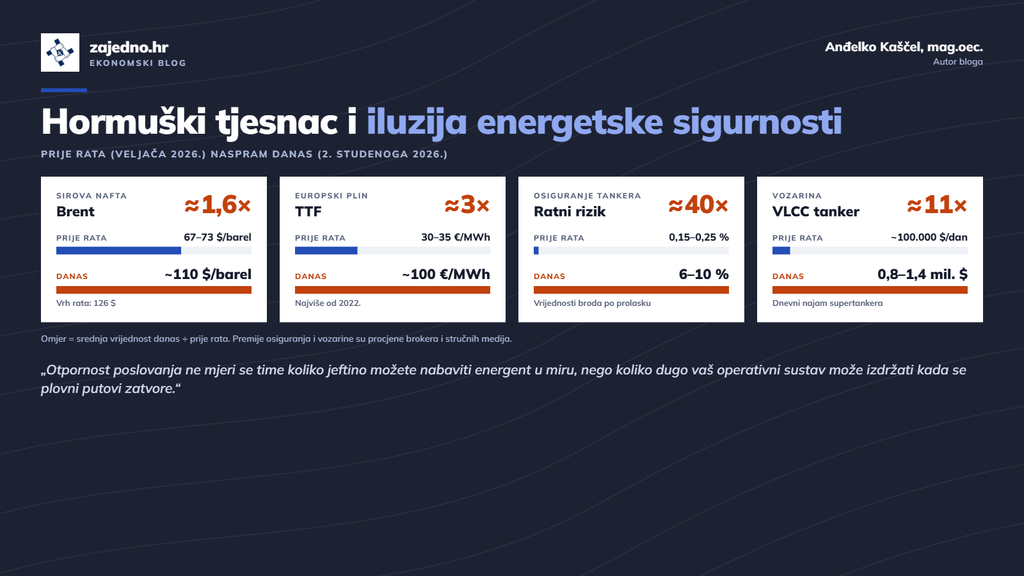
Energy markets have already priced in the shock. Brent crude is holding around $110 per barrel, after a wartime peak of $126, compared with $67–73 before the war. Daily charter rates for very large crude carriers (VLCCs) have jumped from around $100,000 to $0.8–1.4 million. The European gas benchmark (TTF) has reached €100 per MWh, its highest level since 2022, as Europe has lost part of its Qatari LNG supply and is entering winter with historically low storage. While the United States, as a net exporter of crude oil and petroleum products, has a strategic energy shield, European and regional manufacturing remains directly exposed to every disruption of flows from the Gulf, renewing pressure on cost inflation and squeezing industrial margins.
Even if the ongoing negotiations bring de-escalation, the real lesson for business is that global energy stability is not a guaranteed state, but a fragile geopolitical compromise. Companies that base their projections on seemingly calm energy prices, without active hedging and energy diversification, are taking on uncontrolled risk. Business resilience is not measured by how cheaply you can source energy in peacetime, but by how long your operations can hold out when the shipping lanes close.