

Public debate constantly questions why wages in Western economies significantly outpace those in transition economies. Comparing Austria directly with Croatia offers a precise mathematical explanation.
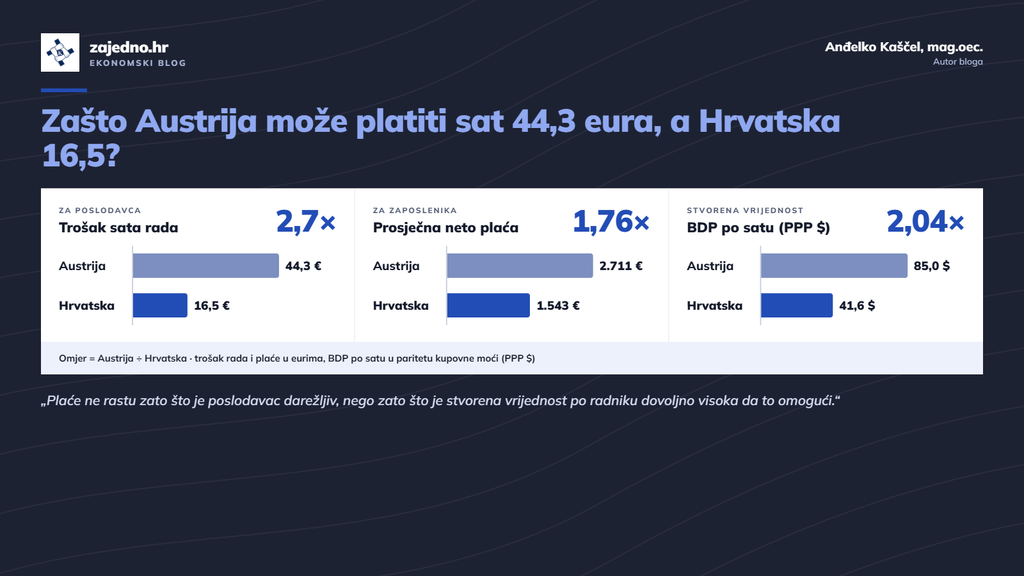
Total hourly employer costs in Austria stand at €44.3, precisely 2.7 times higher than Croatia’s €16.5 baseline. Consequently, an Austrian employee earns an average net wage of €2,711, whereas an average Croatian worker receives €1,543. It is a fallacy to believe that this gap can be permanently bridged through administrative decree or artificial wage mandates. Austrian industry generates $85 in economic value per work-hour, supported by advanced technology and high-margin export specialization.
Sustainable wages do not expand because an employer is generous, but because the economic value created per worker is high enough to sustain them.